KARAKORUM, Mongolia - Bobby is my guide on this five day tour through Mongolia's outer aimags, but since neither my companions nor I are paying her any money for the privilege, we are careful not to make arcane requests. I have not demanded a chance to sample the local delicacy of boodog - lamb mutton roasted in the stomach of a deboned marmot - nor requested a retelling of the her parents' experiences during the Communist purges of the Khorloogiin Choibalsan (Stalin's neighborhood stooge). No, I've tried to avoid anything that might make Bobby reconsider her generosity and run back to Ulaanbaatar.
But I didn't even need to ask Bobby about my greatest Mongol desire: She brought the throat singer to me.
For the final night on the steppe, we drove several hours from Tserterleg to Karakorum, the old Khanate capital. The city is a major stop on Mongolia's minor league tourist circuit. In the summer, thousands of people pass through here to see where Genghis Khan's grandson issued decrees for subjects as far away as Romania. During peak season there are apparently sizable, if not Great Wall-level, crowds but on this blustery February afternoon, I could not see any other foreign faces as we drove through town to our destination: a tiny ger camp at the edge of a field.
Although the tourists are gone for the season, the infrastructure remains. We no sooner arrived than Bobby asked if we wanted to hear a local man perform traditional music in the evening. The cost would be just 4,000 tugrugs, or $3.50 a person. Even though I am generally leery of song-and-dance on the tourist trail, I feared declining might offend Bobby, the sole link to our monolingual Mongolian hosts. We agreed to the show. Bobby went off to contact the performer, but not before - perhaps she felt emboldened by how quickly we agreed - pointing in the direction of the camp's only building, a tiny wooden structure. Inside we found a wrinkled woman with beet-red, wind sheared cheeks, offering dozens of tchockes for sale.
Seconds later, Bobby appears without her usual smile. "The old man did not answer his phone," she said. "I guess he is not home."
Caleb, holding a camel figurine, whispered to me: "That means he's too drunk to leave the house. He's on a bender."
Bobby then left us to shop. We were standing in a one-room house the size of a small walk-in closet, crowding around a few sleeves of knick-knacks, wasting time before a dinner of mutton buuz and pickled vegetables. The Mongolians we encountered (continued to) confounded my western ideas of living spaces. Here the proprietors live and serve meals in a ger, keep guests in a second ger, and use the only permanent structure on their property as a gift shop. Considering the way the gelid winds pierced the cracks in the cabin's siding, my hosts are clearly not irrational, just adaptable.
With the concert apparently off the table, we four guests continued with preparations for our final evening on the road. Caleb fetched a bottle of cheap Russian vodka from his pack, I found bottles of Coke and Sprite for mixers and Myriam produced a pack of cards. But I no sooner dealt the first hands of hearts when Bobby burst into the ger with good news. The old man not only has been found, he is next door, waiting to perform. As a manner of introduction, she asks - in the most pro forma way possible - if we are still interested in a bit of music. When we nod, she sticks her head out of the canvas and gestures with her hand. A few seconds later, the evening's entertainment steps into the ger.
In walks someone who appeared to have several decades of hard-living under his belt. The "old man" - whose Mongolian name I immediately forget - sports a face that is covered not with wrinkles but full crevices, scores of lines that look more like heavily whipped meringue than skin, and eyelashes that bush in every direction except perpendicular to his eyes. Take away his garments, an olive green del with a bright orange cumberbun and a loovus, the traditional Mongolian hat that curves to a point like the onion domes of St. Basil's in Moscow, and the person he would most resemble in America is a Berkley hobo. I am surprised he can walk a straight line from the ger door to small bench, where he lays down his bundle of instruments and begins the show.
"Hello," he says, tentatively, and then launches into what is certainly a well-trodden tour through the Mongolian folk song canon. He sings a tune about doomed lovers, a ballad to the country's open spaces, and two songs about a horse. Between each tune he pauses to tell a bit of history behind the composition, at first speaking in Mongolian and having Bobby translate, but as the evening progresses switching to stuttering English, which is not hard to comprehend.
His act is vaudevillian and high-spirited, he works the claustrophobic ger and audience of five as if playing a large concert hall. He taps his feet with the beat, and flashes his decaying teeth filled smile during the pause between verses and choruses. Instruments are swapped out between nearly every song. He starts with a two-string fiddle known in Chinese as the erhu, which is played by rubbing a bow of horse hair across the instrument's long neck. The next piece is played on a small recorder-like flute, and then he switches to a bigger stringed, instrument, the morin khuur. It resembles a guitar with a square base. Like the erhu, it has just two strings, and is played like a bow. When played by the old man, the tones are long and deep, like the rumble of a commercial airliner high in the atmosphere.
The instruments and lyrics of these songs are secondary to the way they are sung. Bobby did not specifically say the Old Man was a throat singer, but it is clear from the first note that this man has mastered the technique. There is no mistaking the two tones filling the air.
When I first encountered throat singing - on Bjork's 2004 album Medulla - it was like discovering a new, secret part of the English language. It was as if before I was a songwriter composing with just E and F, and suddenly became aware of every other note. Suddenly there was just so much more to music. Now, hearing it performed live for the first time, those feelings of discovery are magnified by a factor of ten.
Throat singing, like everything else alien to Westerners, has now been throughly dissected by scientists and ethnographers. We know that the sound, technically known as overtone singing is produced by changing the shape of the resonant cavities in the mouth and throat. This allows people to produce two pitches at once, as the sound is bounced around in the vocal chambers.
But I don't care if throat singing is easily explained. No matter how hard I try, I can't make my throat make the high and low pitches that I normally associate with hearing tests and dishwasher cycles, yet here most men can do it with ease. I think there is something magical about the magnificently bizarre sight of an aging drunkard making these otherworldly sounds. He may look disheveled, but by the time he finished with a cover of The Beatles' "I Wanna Hold Your Hand" on the horse-head fiddle, it didn't matter. This was the concert of the year.

Friday, January 25, 2008
Deep Throat

Tuesday, January 15, 2008
Try This Tape

ARKHANGAI AIMAG, Mongolia – Battir and I have different tastes in music. He prefers saccharine love songs with milquetoast melodies belted out by Ulaanbaatar's latest pre-fab teen sensation. I prefer, well, not that.
Since Battir is the only person who can drive, navigate and repair our aging Soviet van out here on the steppes, we've been listening to mostly soft rock and power ballads on the trip. As there's no radio stations out of the capital area and no one here possesses an angelic voice, we would be hearing these cloying tunes over and over again, if I hadn't remembered to pack a small piece of plastic. This $10 accessory from Sony is an over-looked but essential bit of equipment for anyone planning on a long overland journey in a third world country.
I'm talking about a car tape adapter, a piece of plastic that resembles a cassette tape with a long cord strung off the end. These devices were popular in the 90's, when they allowed drivers to listen to CD players in older cars. Now most American cars come with CD players standard, and these devices have little use.
Not in Mongolia. On the first day of trip, one hour after leaving the UB Guesthouse, Battir slid a tape into the antique van's antique system. We heard a Mongolian love song, with a Celine Dion tempo and a gently played Casio keyboard. Another song came on, indistinguishable from the first, and another and another. Then, after the fifth song, I heard a familiar drum pattern, then a few keyboard chords I'd heard before. And the singer didn't sound like a copy of the one earlier in the tape, she was a clone. It took nearly 30 seconds - 25 more than it should have - for me to piece together what was going on: the tape had started over.
As we drove through champagne colored fields splattered with a thin patch of crusty snow, the tape looped and looped. Out of courtesy, I said nothing. I concentrated on the alien scenery, counted the stray sheep and tried to remember every state capital. Anything to drown out the muzak.
By lunch on the second day, I stopped being polite. I rummaged through my internal frame pack until I found the cassette adapter and marched over to Battir. Now, it took me some to do this. Battir is an imposing figure, a gigantic six-foot five inches with a rotund belly. At age 26, he is still growing. He easily consumes twice as many buuzat dinner as any other member of the crew, and on some nights approaches our combined food intake. Battir wrestled as a teenager, and competed in the national championships during the Nadaam Festival, Mongolia's most important holiday. He's massive man, someone who in America would be a bouncer at a gentleman's club.
Thankfully, I've learned this guy is a big softy. My first was the music - a Mongolian alpha-male listens strictly to gangsta-rap. Then there's the smile. It's hard to be afraid of someone, no matter how big he is, when he wears a goofy grin from cheek to cheek. Battir's is constant. Whether unloading hundreds of pounds of luggage from the van or checking the oil, he never stops smiling.
Confident the man wouldn't try any wrestling moves, I gave Battir the tape and pointed to the player. "Put this in there," I said, even though Battir doesn't speak a word of English. And with a smile, he did just that.
Half a second later, the booming bass of Basement Jaxx's "Where's Your Head At?" came on the stereo. It's been a long time since I've heard Western music outside of my teeny iPod earbuds, and it sounded great. All that afternoon, the car worked through a lengthy playlist of hit songs. We sang along to R.E.M., U2, Nelly, Jay-Z and Eminem. It was wonderful, even if I did sing slightly off-key.
Saturday, December 29, 2007
Sad, Sad Jazz
ULAN-UDE, Russia — I'm a bit homesick.
That can happen during dinner at a place called the Fast Food Café, a Russian establishment that specializes in bringing America to the cold, dark taiga.
I wound up here because I couldn't find any other tasty-looking options in Ulan-Ude's main area - other than a giant Lenin head.
At the Fast Food Café, food is ordered cafeteria-style. The diner takes a tray and pushes it down three parallel metal rods, stopping to take any food that looks edible. On offer are Russo-ifed versions of American favorites, including fried chicken, hamburgers and hot dogs. Healthy dollops of Russia's national condiment and spice, mayonnaise, is sprinkled on top of everything, including the fruit and Caesar Salad. I have to request a custom order, which is difficult when your Lonely Planet Russian Phrasebook is back on the Trans-Siberian, speeding toward Vladivostok.
"Nyet mayo," I say, hoping for cognate. The kitchen worker, about 18 with her hair in a messy ponytail, doesn't get it. I point to a hot dog with three huge kosher pickle slices and a thick squirt of mayo on the top. "Nyet, nyet, nyet," I say. This time she starts to move, although shoots me a look that seems to say that she can't understand why I'd desecrate an American treat by eating it without sauce.
I grab a bag of chips, pay for my food and then go to the bar, where there's Budweiser, Heineken and Baltika on tap. I choose the native brew (#7), and look for an open seat. I find a line of empty stools facing the street windows, and take one in the middle.
The café is obviously a popular weekend hangout for the city's teenagers. And why wouldn't it be? The food is reasonably priced, and minus the mayonaise, pretty tasty, there's bunches of Ikea-knockoff tables in various sizes for small, medium and large groups and friends, and an attached movie theater and video arcade. As I take my third bite of processed pork, the house band starts to play. It's a jazz-quartet of balding middle-aged men in black T-shirts and leather coats.
They play the theme to "Titanic," then "The Bodyguard." The young patrons keep chatting away, but I stop doodling in my brown trip diary. The music choice is mawkish, but it's redeemed by the incredibly tight playing in the group. And here, in this artificially American environment, my mind turns to schmaltz. I'm 9,000 miles from home, in an incredibly foreign city. I haven't had a proper conversation in 10 days. The Internet Café blocked Skype, Gmail and AOL Instant Messenger, so I can't have even an electronic conversation with my friends and relatives. I'm cut-off, on assignment far away from my former life.
Eventually it's time for "Young Hannibal," the third sequel to "The Silence of the Lambs," in the attached movie theater. The film is slow, suspenseful and punctuated by random acts of violence. The atrocities on screen are horrific, . Lecter's enabler is Gong Li, the ravishing Shanghainese actress who made several key Zhang Yimou movies, including "Raise the Red Lantern," "Ju Dou," and "The Curse of the Golden Flower." A key section of the narrative takes place in Kaunaus, Lithuania, a town I passed through just a couple weeks ago. The film is dubbed into Russian, and with no recognizable dialog I stay stuck on the remembrance of things past.
After the film I grab another drink from the Fast Food Café bar. I scribble a few postcards, feigning being excited by my adventures when tonight I'm worn down. The band is between sets and a DJ is spinning songs popular during high school. Aalyiah's "Try Again." Pink's "Lady Marmalade" cover. Eminem's "My Name Is."
In China half the bar would come up to the strange redhead and practice their English. Russia is not China, here they leave the tall man writing in a worn, stained brown notebook alone, and don't ask if he needs help getting home after three beers and an equal number of hot dogs.
It's a cold, uphill two kilometers through half-lit streets back to the Hotel Udon. I don't want to risk riding a bootleg taxi at night in this foreign city, so I pull up the fur lined hood of my down parka and start the trudge. As I walk the jazz music echoes through my head, and eventually the cold is replaced by melancholy for things left behind on the road.
Sunday, December 16, 2007
Purgatory
PERM, Russia — The Trans-Siberian is as close an experience to Purgatory as is possible in the Earthly realm.
This is especially true of the middle days in the journey, the ones where there is no arrival nor departure. The day begins and ends on the train. There is nothing in particular to look forward to, everything that exists at the reveille where be there at bedtime, and the day's only marker will be that the destination is now just three days away as opposed to four.
Being stuck on a train for so long means that at some point, the traveler must surrender the idea of the destination. It would be madness to countdown the minutes in an 84 hour journey across the tundra. Instead the train must be accepted as a new way of living.
No longer I am bound by expectations or goals, there is no point to life on the train. The car will move 1,000 miles today whether or not I brush my teeth. I could not move from my bed, and it would still be a successful day. The key to making it to Ulan-Ude is forgetting that there is an Ulan-Ude, and then just be.
My entire existence is a train car, and most of the time there I am confined to the compartment. The four of us are not overly compressed inside, and I am especially fortunate to have a top compartment. This means I have the luxury of returning to my own personal space at any time, where I can lie flat or sit Indian style, face the window or the door. During the day I spend most of my time on the bottom bunk, with doubles as Olga's bed at night. Usually I sit closest to the door, Olga near the table, but sometimes this can be reversed. If Sergei is out sometimes I stretch my feet across the aisle, legs flat. This is my favorite position, it feels like a recliner.
What do I do in these various seating positions? There are first and foremost the distractions I brought aboard. My iPod is best, with its 3,900 songs and 200 Podcasts. I learn about a new digital camera with 10 megapixel resolution from David Pogue of the New York Times, investigate North Korean counterfeiting with a reporter from the BBC, and wonder with the Slate Gabfest crew if Barrack Obama's campaign will fly. There are songs, too, my favorite being from the group Peter, Bjorn and John. It's called "Defects on My Affection." The chorus asks a single, piercing query:
"The question is
Was I more alive than I am now?
I have to happily disagree.
I laugh more often now,
I cry more often now.
I have to disagree."
I play the song twice, but then save the third repetition for inside my head. There's no way to charge the device on board, or at least now way that I can figure out. That means I'll have to make the trip on only one tank. I shift my iPod use to maximize battery life: backlight turned off, no skipping songs, no games, no video. I carefully make playlists and don't deviate from them. Even with careful rationing, the battery looks like it won't make it past day three.
I also brought books. I could see my mother's brow furrow when I decided to bring eight books and an equal number of socks. She tried to convince me that I might not need a book about Eritrea. Combined the books weigh about 15 pounds and take up quite a bit of space in both my suitcase and pack, but I don't care. They're worth every ounce. Today I pounded through this year's Booker Prize Winner, The Inheritance of Loss. I bought this for my sister at Christmas, but after she pounded through the copy I swiped it and brought it out.
The novel centers around several people tied by an estate in the Indian town of Darjeeling. The patriarch lives a lonely existence on the fringes of the Himalaya, content to be alone while the other people pine for Delhi and New York. Although written by an Indian-Englishwomen, the book is Russian in scope, chronicling three generations of despair. These are lonely, desperate people, who live broken lives and yearn for an emotional payoff that never comes. Reinforcing the link to Russian literature is a strange plot detail: the little girl who figures in most of the story is the daughter of Indian astronauts both killed on a mission in the Soviet Union. Since this act sends most people in the book into the pit of misery they will stay stuck for the rest of their lives, it could be said that Russia is these people's undoing.
And that's about it really. Besides reading and listening to music, I eat, go to the bathroom and stare out the window. It sounds terribly boring, and somewhat quixotic. Why go all the way around the world to do something easily accomplished on the couch with a bag of Doritos? But inside today's nothingness there were moments of transcendence, when everything felt all right with the world. Even though I'm not doing anything, it still feels like I am on an adventure, crossing the terra incognito on the map. I may be in purgatory, but I'm strangely alive while serving my time.
Monday, April 16, 2007
Straight Outta Ulaanbaatar
DARKHAN, Mongolia – After the old Russian woman in the top bunk went to sleep, Sumar brought out his laptop videos.
As our train slowly passed through the pitch-black Mongolian grasslands, Sumar eagerly showed me what he'd downloaded at university in the Siberian city of Irkutsk. First he went through his collection of basketball clips, where members of various NBA teams made incredible shots during the last seconds of important games. Then came a video shot at art exhibition of a Scandinavian man creating shadow puppets using sand in time to a pre-recorded soundtrack. After that, Sumar clicked on the folder called "Music."
He opened the first file. The name was Cyrillic but I recognized the video from the first few frames. It was Nelly's "Hot in Herre," the most popular rap song of 2002.
"I love Nelly," Sumar said. "He's my favorite." We then watched most of the Nelly catalogue, including "My Place," "Country Grammar," "Flap Your Wings," and that song about chilling with my boo. Sumar then asked if I wanted to hear some Mongolian music, to which I quickly replied, "Yes!"
He queued the video on the computer, waiting for Windows Media Player to load. At this point I had only been in Mongolia a few hours, and had just heard the language for the first time as I snuck across the Russian border in a van full of traders, with hidden human cargo in the back seat. The beat started rumbling, a mix of deep bass rumbles and quick drum hits. A Mongolian flashed across the screen, dressed in urban clothing on top of a building at night. He started to rap in a guttural burst, delievering his lines in a way that seemed half rap-half chant. Accompanying the music were gritty shots of Mongolian urban life: monks fighting, police brutality, strippers, poverty and crumbling Soviet buildings. This was the music of Zaya, a song called "Tears of Ulaanbaatar," his first solo recording away from Mongolia's biggest rap group Tatar.
The beats, the songs, the setting: I loved it all. Perhaps this is the way people felt when they heard Led Zeppelin or the Beatles for the first time, falling completely in love with something so unexpected. I knew that I needed to get this record, immediately. Sumar only had the video, but suggested that I try to buy the record in the capital. He wrote down the name of a couple record stores in Ulaanbaatar and included a couple of Mongolian swear words to boot: Alna shuu! Muu nohoin gölög min! If I remember correctly, this translates to something along the lines of "Fuck you! I fucked your mother last night!"
The next morning I set out to find the Zaya album. At the State Department Store they didn't know anything about it. Hi-Fi Records said it wouldn't be out for another two months. The Hip-Hop Clothing Store no longer sold music. This being Mongolia, the options pretty much ended here.
With no music, I collected stories about the rapper. People in Ulaanbaatar told me about concerts they attended for Zaya's old group Tatar. They talked about the group incited a riot and the police started beating the crowd. A Peace Corps worker in Beijing told me that he'd seen the video six months earlier, but hadn't heard anything about a release. A Mongolian on my floor here in Tsinghua – who, the first time he met me, said, "What up Motherfucker!" – definitely wanted to buy the album, but definitely didn't have it yet. Another student offered to mail me a copy when she went home on spring break.
Then last night I was bumming around on Youtube, when I put in the name "Zaya" and "Ulaanbaatar." One result appeared, and it was the correct one. So now, thanks to the magic of the Internet and a poster named Munko, I can share the video with you. Enjoy:
Saturday, April 07, 2007
The Day the Music Died
BEIJING - At the back of the Dongyue Temple in Beijing's Chaoyong District, there is a lovely courtyard. I wish I could give period dates or accurate descriptions of its features, but alas I never got around to studying imperial architecture in college.
Nevertheless I can say this is the Chinese courtyard as imagined by young Sinologists all over the world, with shiny blue curved roof tiles and large red lanterns hung every meter on the outside of the crimson-colored hallways.
The Dongyue Temple admission ticket includes entry to this courtyard, which is located behind the main Daoist statues and relics of the temple. My ticket - normally 30 RMB, but just 5 RMB with a student card - says this is the "Beijing Folk Museum," and is the only place in Beijing where large folk performances can be held.
Behind the final statue hall, roughly in the middle of the courtyard, is a large, tacky stage that is used for performances. It's brand-new, and designed in the Chinese "shiny red thing" category. All over China these tacky balloons and pixelated background montages are ruining historical sites and downtown shopping malls alike. The Dongyue Temple was no exception.
But despite the intrusion of the tacky, I still had a wonderful experience in the courtyard during my visit last summer. I visited the temple on a hot, sunny afternoon by myself, wanting to kill a couple hours before meeting an American friend in a language program. As I entered the courtyard, I heard music coming from a back corner. Three young musicians were playing Chinese instruments. One was the erhu, the other two I didn't recognize.
I went upstairs and stood next to where they were playing. The music was lovely, the perfect antidote to the broiling hot weather. I sat down and listened for over half an hour, nearly falling asleep to the sounds.
Yesterday I returned to the temple with a couple friends, and went back to that courtyard. There were no sounds, and no musicians in sight. A few workers played cards, uninterested in the few people at the temple. I again climbed the stairs to the second floor, and walked in the room where I heard people playing. There I saw a couple instruments, and three young Chinese, dressed in traditional but ill-fitting costumes.
I asked one with long curly black hair (recent perm?) when the music was going to start.
"Today's there's no music," she said.
I asked her if there was ever music. She said on Chinese New Year sometimes there were performers, other times no. I protested that I had heard music there nine months ago. She seemed confused, and called over a colleague. Yes, he said, there used to be musical performances, but now no longer. The music had died.
Thursday, December 28, 2006
The Slow Become Slower
ALBANY, N.Y. - I may be on America's East Coast, but the Taiwanese earthquake slowed down my Web surfing. My attempts to check the progress of my language school applications - never an easy process - the last two days have loaded at one-quarter or less of their regular sluggish pace.
I think I'll take a couple days off from Baidu MP3 search as well. That means no more cheesy Chinese disco-pop songs until the New Year.
(The above video is for a New Years song by the China Dolls, whom I know nothing about.)
Tuesday, October 24, 2006
Marie
ALBANY, N.Y. - The "Marie Antoinette" teaser is one of the best. Kristen Dunst runs around Versailles, playing with sparklers and dashing through gardens in the pre-dawn like a teenager on prom night. The montage is set to New Order's "Age of Content," a mix of fast guitar and mournful synths which is now one of my iPod's most played songs. I loved it, and so did several of my friends.
We counted down the moments until "Marie Antoinette" opened in theaters. We cringed when we heard reports that some bbooed the film at Cannes. Roger Ebert said it was just a couple people, and the French like to boo films anyway, we said. We were a tad baffled when a second trailer was released, with more running around Versailles but this time with the god-awful Strokes in the background. We wondered when the reviews were very mixed.
Finally, we got to see the movie.
Sadly, it wasn't great. The plot wanders, and even a wonderful soundtrack of ambient and new wave music (that Strokes song excluded) can't make up for a lack of resolution. The movie's more a mood piece than anything else.
Last week in Scranton, my friend Nazy told me, "prepare to be disappointed," and I was.
If the movie didn't quite work, there were still many scenes that brought out the same feelings of young restlessness that made Sofia Coppola's last film "Lost in Translation," a touchstone for many of my friends. We identified with both the heroine and Bill Murray's character, the uncertainty of what to do with life and also the perils of what can happen if we choose incorrectly.
And that was worth the price of admission.
Friday, September 01, 2006
Miss Penny Xu
WICHITA, Kan. – Rumor has it China is everywhere. You could tell that to the Kansans, but I'm not sure they'd believe you.
Two months on here in America's Heartland, I've had surprisingly few China-related adventures. I haven't written about the country, or any Chinese-Americans in my stories. I really haven't been in any situations where speaking Chinese could remotely be considered helpful. And so, the China has dried up from this blog.
This afternoon, I saw an interesting link while trolling the Web for a potential story: "2006 Wranglers China Tour."
The Prairie Rose Wranglers are a Kansas institution, a performance group comprised of mostly teenaged singers. They perform traditional Western ballads and songs, at a dinner theater 10 miles outside of Wichita. The Prairie Rose singers and unlimited BBQ cost $25, or $22.50 for groups of 10 or more.
They've entertained tens of thousands of people over the past couple decades, although probably not too Chinese. An entertainment agency set out to change that, and took the group over to China last spring. They came, they saw, they sang their tunes in Beijing, Shanghai and Xi'an, and left.
From the coverage in the paper and other local media, you'd think these were the first white people to ever set foot in China.
"I'm the luckiest kid in the whole world," an 11-year-old told our paper. Another child said he was worried about eating two weeks of only Chinese food.
I took issue with a couple things:
1. They claim to be giving the first musical performance on the Great Wall. They could have given the first musical performance of the Great Wall... on the day. But, no, many a people have performed on those steps. Even I sang "Hollaback Girl" on the wall.
2. Their motivation is apparently to meet "the Chinese people." I'm skeptical. Who are you meeting as you zoom through the country in a giant tour with no Chinese?
The whole trip seemed like a giant missed opportunity. Why were these guys stuck in the boring big cities? Why didn't they go to see China's real-life cowboys? Now a joint performance of a Tibetan chanting and doo-wop songs about "Missy Penny Sue' is something I'd pay 25 RMB to see. I might even pay $25, if it included some BBQ.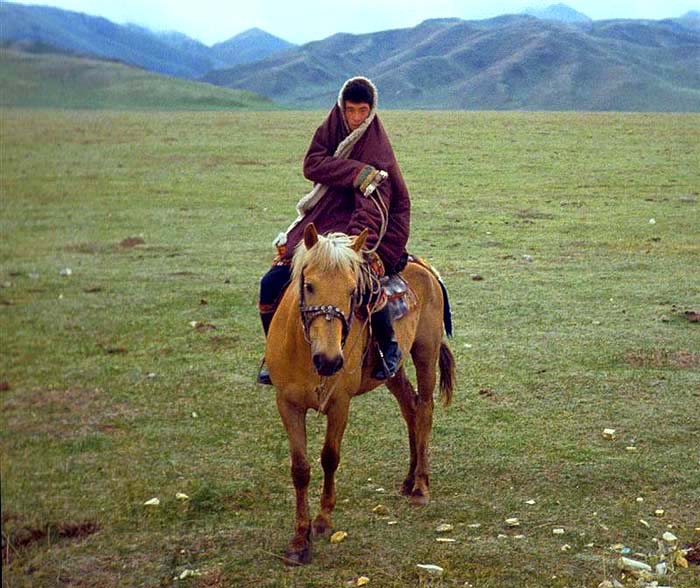
Sunday, June 04, 2006
Shopping for Hong Kong's Next Megatalent
HONG KONG - I've never been one for "American Idol." I could never get too excited by a bunch of teenagers from Kentucky squaring off to win the favor of Paula Abdul by singing hopelessly sacrine renditions of Barry Manilow songs. Clearly 40 million Americans, and the hundreds of millions of others who watch around the world, disagree.
Competition does excite me. When I saw that the nearby Westwood mall would be having a "Chinese Folk Singing Competition" this Saturday, I was interested. It didn't matter that the sign advertising it was all in Chinese, and didn't list a time. I was there.
I wandered over to the mall around 1 p.m. This turned out to be the perfect time, as the concert was in high gear. The first performance I saw was two teenaged men, each with guitars and harmonizing in Cantonese. I didn't recognize the song, but they were pretty tight.
There was about 100 people in the crowd, young children, some clutching guitars and all fussily dressed, with their parents. This competition, it turns out, was strictly for children. 
The next contestant was a young girl, who was maybe 7. She got up and started singing. The song was "It's the End of the World." Not the REM song, but an old standard, sung in English. Her tone was good, but it was clear she definitely didn't speak English had just memorizied the lyrics.
The judges seemed to like it. There were two of them, dressed formally and gazing constantly at the singers. They were positioned for maximum drama - only about two meters from the stage and blocking part of the audience. For the performer, they were the only thing that mattered.
The third act was better. This person was a bit older, maybe 16, and dressed very fashionably. This was fashionable in the Hong Kong sense, so that meant ripped jeans with a lot of pockets. He opened his mouth, and I couldn't believe it: out came "Wonderful Tonight," by Eric Clapton.
It's a nice song, but this guy didn't have the range or the language skills for it. I'm not sure if he knew this was about a man and his wife, or just generally about life, but by just shifting the accent from the "wonderful" to the "tonight," all feeling seemed lost. He played guitar quite well, but just couldn't connect.
After that I left; I'm not sure what the results were. My vote was with the "The End of the World" girl. But I do know that the definition of "Chinese folk singing" is much broader than I originally suspected. Maybe at the next competition I should enter. I can do a pretty mean rendition of "Crazy."


