ALBANY, N.Y. - A Brooklyn man's death on the Northway, frozen 100 miles north of Albany on the side of a major highway, is a tragic failure of environmentalists, developers and engineers to properly manage New York's wild areas.
Rather than hammer out a practical solution to providing cell phone access to the nearly 70 mile corridor that begins at Exit 28 (although cell service can be spotty all the way to Exit 22), lawmakers failed to make the necessary compromises and let the issue stagnate.
Phone service in the corridor used to be provided by emergency access phones, spaced every two miles on each side of the road. When our family minivan broke down in the early 1990s, my father hiked nearly a mile to reach the phone. Less than an hour later, my grandparents arrived, shepherding the family to safety in their station wagon.
The phones fell into disrepair and were removed several years ago. With cell service not available, there's no way for a stranded motorist to alert the authorities that help is needed.
It was only a matter of time before someone wound up trapped, and unfortunately, dead.
I don't support extending cell phone service to the entire Adirondack region. It would be an unnecessary intrusion into a place designated "Forever Wild" in the state constitution. People who venture into the string of mountains known as the High Peaks need to be prepared and self-reliant.
But the same burden cannot be applied to people transversing the Adirondacks as a means of traveling between New York and Montreal. All sorts of people must go through this area - the old, infirm and disabled included - and we must provide state of the art communications technology.
The Adirondack Park Agency approved 33 cell towers, each 38 feet tall, to provide service to the area. Cell phone companies balked at the cost, and wanted to install a few much larger towers. This is a mistake; the small towers are already approved and should be completed quickly.
As the Schenectady Gazette says in today's (unavailable online) editorial, "Time to resurrect that plan and figure out a way to get those towers built before another winter passes!"

Tuesday, January 30, 2007
Cell Phone's Dead

Thursday, January 25, 2007
Scarves
NEW YORK - It's the winter farewell of mothers in cold climates around the world: "Don't forget your scarf!"
On New York's coldest day in two years (Central Park bottomed out at 5F), I didn't forget mine. I clipped the tag off my grey cashmere Christmas present from J. Crew, threw it in my shoulder bag, and caught the 8:15 a.m. Harlem Line train to Grand Central Station.
Two hours later, I stepped out of the 23rd street subway stop into a brisk Arctic wind. I went for my scarf, pulling the two feet of material into my gloveless hands. Then I realized I had no idea how to put it on.
Scarves are the least initutive winter clothing accessory. Hats slip on top of the head, boots are shaped like feet and gloves have finger holes. But a scarf doesn't look anything like the part of the body it's designed to protect. Sure, there are neckbands, but I didn't catch anyone in one of the world's most fashionable cities with a noodle-shaped piece of fleece.
My first idea was to take the scarf, wrap it around my head and let the remainder hang off the back of my shoulder.
Bad idea. The dangling end was too long, drapping nearly to the ground.
Too timid to ask someone, I looked around the city for ideas on how to properly arrange a scarf. I saw a few people with the drapped method, which had just failed me, but most appeared to have it tucked inside their coat somehow.
I kept seeing people with the scarf as a loop, displaying a symmetrical curve in front of their coats. It looked neater than the dangle, and offered protection from dirt and snow outside.
I tied my scarf into a loop and walked from the Russian travel agency on 20th and 5th to the Chinese consulate at 42nd and Riverside (a distance Google Maps places at 2.3 miles).
The loop had several positives: it stayed in position, looked nice and kept the neck warm. Unfortunately, it also left my now warm neck feeling itchy and my chin closed. Taking all the fabric in the loop around my neck meant there's no extra room to cover up the bottom of the face. I wore a hat with ear extensions, but it left the area around my mouth exposed.
Leaving the Chinese consulate, I put on my coat, hat and re-laced my shoes. When it came time to decide how to arrange the scarf, I tried a new method. I left it in the bag.
Iwo Jima Mess

NEWINGTON, Conn. - I'm here at the National Iwo Jima Memorial Monument just outside of Hartford wondering why well-meaning people sponsor advertisements at places of mourning.
Here you can see an impressive replica of the famous shot of American soldiers raising the flag on a small Pacific islet. Right next to the towering rock carving is a notice that several local car dealerships help make this monument possible.
I understand that government of a small Connecticut town might not have the money to import and carve a monument of this size, but they shouldn't resort to cheap sponsorship.
The main parts of the monument, the statue and a eternal flame, are dedicated to all soldiers that fought at Iwo Jima. But other parts of the monument imply that its more dedicated to certain soldiers. Families purchased small bricks, so certain soldiers have their names individually listed on the ground, while others don't. The chaplains get a personalized plaque enumerating soldiers served, injured and awarded the Bronze Star. Other units do not.
Don't expect a quiet visit. The entire monument is right on the side of a four lane divided highway, The Iwo Jima Expressway.
In front of the monument is a large slab of black granite that says, "Welcome to the Iwo Jima National Monument." On the back, in equally large letters, the name of the person who donated the piece of stone. It serves as an exit sign to the memorial.
Responsible for this mess is the Iwo Jima Survivors Association, Inc., a local group that raised the money for the monument. While I'm sure their intentions were good, I don't appreciate the results.
The best monuments tend to be the simplest ones, where a tragedy, victory, or person is reduced to one or two powerful messages.
That's why I'm bewildered by the continuing controversy over the Sept. 11 memorial in New York City. Some victims' families are pressing for more information be included on the memorial, including ages and division of law enforcement. One group is airing an ad on New York television that declares the current proposal "a cold, random list of names."
I hope New York Mayor Michael Bloomberg aren't persuaded by these arguments, as I someday would like to see a simple, powerful monument to that awful day. Adding more details about individual people categorizes them, making one life seem more valuable than another. The "cold, random list of names" shows that each loss is equally terrible.
Maybe the mayor should use some of his personal wealth to run a response ad, showing images of this Iwo Jima monument as a frank reminder of what can happen when the monument planning process runs amok.
Wednesday, January 10, 2007
The Day the Funny Juice Got Loose
NEW YORK - I caught the city in a philosophical mood today.
Maybe people were still feeling lightheaded after yesterday's mysterious gas smell floated around the five boroughs, but everyone kept spouting deep thoughts.
"We're all connected somehow," a window washer said in a thick Queens accent to a colleague on 23rd Street, working without gloves on a relatively mild January afternoon.
Significantly more dressed was the haggard crowd in front of the Russian consulate. A six-person wide queue stretched from the embassy door to the street corner 200 yards away. The faces of the line were dour: old babushkas hiding behind tattered handscarves, slightly younger men with jackets brought over from some Soviet Republic. These faces said: leave us alone; we're sitting in this line, suffering quietly and reflecting on our lives. Don't come near.
I decided to skip the line. Through the phone book I found Olga, Russian travel agent. She promised to get rid of my visa problem for $30, and offered some free advice to boot. Those old people were pensioners, applying for their annual stipend from Moscow. The consulate's closed for the first eight days of the year for Orthodox holidays, this was the first day they were open. The pensioners emerged from their tiny apartments in the outer boroughs to make sure the Kremlin coughed up their few extra rubles.
Olga shrugged. At least they were here in America, where grumbling thankfully is not a crime.
Dinner was at a Japanese tapas joint in Astor Place, Kekan, where diners can take a break from the soundtrack of 1960s J-pop hits in an enclosed smoking chimney. It's soundproof, so people can share secrets in plain sight without other diners catching on.
On the way back upstate, my train spent nearly a half-hour idling at the Harlem stop. A drunk man in the back of my car started yelling. "I take the train like twice a fuckin' year, and this happens once. What the fuck?"
Perhaps he didn't get the memo. Today, the city's thinking.
Wednesday, December 20, 2006
Small But Sexy
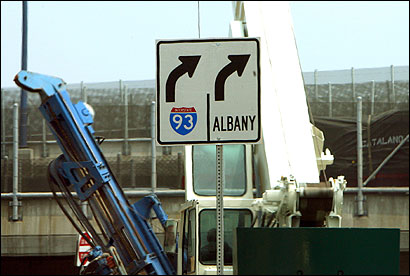 ALBANY, N.Y. - Called "Smalbany" in the current Lonely Planet (a term I've never heard used by a local) Albany gets a bad rep. The truth about New York's capital is best summarized by a transplant I spoke with at a holiday party.
"People think Albany doesn't have anything. That's wrong. Albany has one of everything," she said.
I'm reminded of a statement Berlin Mayor Klaus Wowereit said a couple years ago, that his city was "arm, aber sexy," - poor but sexy. Here in Albany, we're small but sexy.
And my party friend's right about the number of things in Smalbany. There's one good tea store, one buffalo farm, one nice Hindu temple, one controversial Guayanese club and one place to buy stinky tofu.
It's not perfect; every year the local alt-weekly Metroland complains about the city's lack of an Ethiopian restaurant. But with that Horn of Africa power busy "liberating" Somalia, that might be a good thing. There is Yonder Farms, a market less than a mile from my house with a working water-wheel and greenhouse in front, that I go years without visiting. Eating food by using bread as a utensil might be a little much for a year that has already seen the opening of several upscale clubs, lounges and even a "contemporary pub" (aka a bar with fancy appetizers).
Albany's nicest venues, the Emperor's Place serving Cantonese seafood dishes, the politico hang-out Jack's Oyster Bar and the free display of modernist and cubist sculpture at the Concourse are fantastic, they rival their counterparts in New York. The only difference is that here in Albany we only have one of them.
SmAlbany, the blog, examined the differences between New York and Albany in a post called "The "intellectual" roots of Oh, SmAlbany!"
Sample:
New York - "high paying job in the 'financial district.'"
Albany - "cushy and comfortable job with the state."
New York - thinks the "in-town" newspapers are so lame. Reads LA TIMES.
Albany - thinks the "in-town" newspapers are so lame. Reads NY POST.
I've been back in Albany two months now, and think I'm beginning to get settled in here. The other day I even thought about buying a copy of the Post.
Friday, October 20, 2006
A Local Tabloid Worth Reading
NEW YORK - One thing I absolutely love about New York (and Madison and Chicago): The Onion in print.
Reading the stories online, without many of the graphics and local content can't compare. Long live New York.

